Why CV Axles Matter for Vehicle Performance
Fundamentals
CV Axles Fundamentals
Constant velocity joints, because of their unique ability to overcome some of the design limitations of conventional Cardan-style U-joints, have become a common component on many of today's drivetrains. You'll find CV joints used on many rear-wheel drive (RWD) and four-wheel drive (4WD) vehicles as well as on all front-wheel drive (FWD) vehicles.
Some type of flexible coupling is needed on all open driveshafts to accommodate the up and down motions of the suspension. What's more, some means of allowing the driveshaft to change length or to "telescope" in and out must also be provided because the distance between the ends of the shaft changes as the operating angle of the shaft increases.
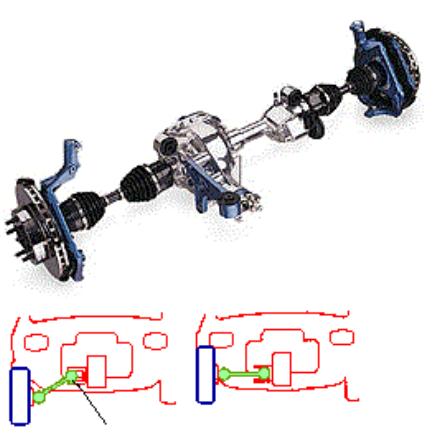
What causes a driveshaft to change length as it swings up and down? The geometry of the suspension. In a FWD vehicle, for example, the arc through which the front suspension travels is determined by the length of the lower control arm (Figure 1). Up and down motions of the suspension cause the front tyres to scrub in and out slightly. Since the driveshaft (which we'll refer to as a 'haftshaft') is almost always a different length than the control arm, it wants to swing through a longer arc than that of the suspension. This would create an interference angle between the two that would tend to bind up the motions of the suspension. That's why the driveshaft must be able to telescope in and out (Figure 2) because doing so enables it to follow the same arc as the suspension.
Contact us in Columbus, Ohio, at 380-210-0807 for expert guidance and premium CV axle solutions built for reliability.